The Confidence Trap: Why Founders Overestimate Their Customer Knowledge
Most founders tend to be natural storytellers. They have to be. Pitching investors, rallying their team, and selling products all require a compelling narrative. But the problem is, a lot of times compelling narratives tend to lack verifiable data.
Research has repeatedly shown that analysts frequently misinterpret storytelling as reliable evidence, leading to governance issues and mispricing. The story sounds great. The logic seems airtight. But the underlying assumptions about customers? They often go untested.
This creates a dangerous feedback loop. Founders build a story around who their customer is and what they want. The story is repeated internally until it becomes organizational truth. It gets to a point where decisions are made based on that "truth." And when results don't match expectations, which they often don’t, the response is usually to double down on the same tactics rather than question those foundational assumptions.
The LinkedIn community explored common founder misunderstandings, and highlighted this pattern clearly. It became clear that founders frequently misunderstand their customers by making assumptions rather than collecting real insights. This misunderstanding leads to wasted effort and stalled growth. And the rough part is, it’s completely avoidable.
The issue isn't intelligence or effort. It's proximity. When you're on the inside, you see the product through the lens of what you intended to be, rather than through the lens of what a stranger experiences when they find your site for the first time.
The Biases That Distort Customer Understanding
There are several cognitive biases that systematically distort how founders perceive their audience. Understanding these biases is the first step on the way to correcting them.
Confirmation Bias
You discount evidence that contradicts the evidence you already believe. If you think your customers care most about product quality, you'll remember every review that mentions quality and forget the ones complaining about shipping times or confusing site navigation.
The Curse of Knowledge
Once you know something, it’s almost impossible to unknow it. You understand your product's value proposition instantly because you’re the one who created it. But a new visitor doesn't have that same context. They need to be guided through a journey you no longer experience because you’ve moved past it a while ago.
Survivorship Bias
You hear feedback from customers who bought, but you rarely hear from the hundreds or thousands who visited, considered, and left without buying. The feedback you receive is inherently skewed toward people who already converted despite whatever friction was experienced on your site.
False Consensus Effect
You assume your preferences and behaviors are more common than they are. If you prefer minimal design, you might assume your customers prefer the same. If you'd never use a chatbot, you might assume your customers feel the same way, even if data clearly suggests otherwise.
These biases don't make you a bad founder or brand owner. Not at all. They make you human. But in the e-commerce world, where decisions are made in seconds and alternatives are a simple click away, even the smallest misalignments between what you believe and what's actually true can have massive impacts on revenue.
What Founders Get Wrong Most Often
Based on patterns we’ve seen across brands, these are the most common areas where assumptions diverge significantly from customer reality.
Who the customer actually is
Brand owners often have a mental image of their ideal customer that, unfortunately, doesn't match who's actually showing up and buying. We've seen brands target one specific demographic through their messaging while their actual purchasers couldn't be more different in age, gender, or overall motivation.
One case that stands out involved a wellness brand where the founder was fully convinced their primary audience was male. The website hero image featured a man using the product. But when we analyzed the actual customer data and ran tests, we discovered the audience was overwhelmingly female.
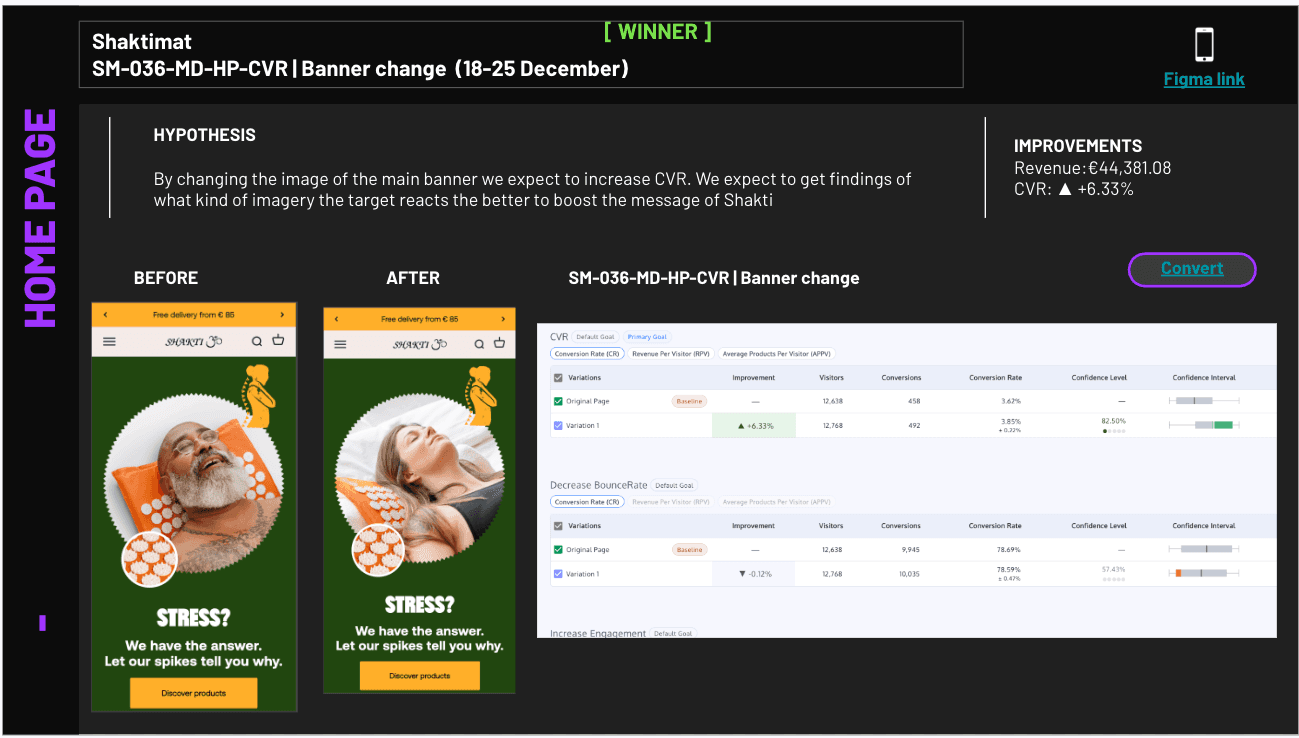
Replacing the hero image with a female model – a change initially met with resistance from the founder – resulted in a significant uplift in their overall conversion rate. The owner of the brand had to be convinced to even run the test because the assumption was so concrete. However, the data told a completely different story.
What customers really care about
Founders often lead with features they're proud of such as technical specifications, manufacturing details, ingredient sourcing. But in reality, customers frequently care more about simpler things: Will it solve my problem? Can I trust this brand? How fast will it ship? What if it doesn't work?
The gap between what founders want to communicate and what customers need to hear is where messaging falls flat.
Where friction actually exists
Brand owners can navigate their own sites with ease because they know where everything is. They don't experience the confusion a new visitor feels if the navigation is unclear, when product options are overwhelming, or when the checkout process is overly redundant, or asks for too much information.
The friction that kills conversions is usually invisible to the people who built and operate the site.
The Data That Reveals What’s Missed
The antidote to all this bias is structured, systematic data collection that sheds a bright light on customer reality rather than assumptions.
This is exactly why we approach CRO audits as a combination of qualitative and quantitative analysis. Neither one by itself gives you the full story.
Quantitative data – Heat maps, click maps, scroll depth, and funnel analytics shows what users do. Where do they click? How far do they scroll down the page? At what point do they abandon the checkout? This data reveals behavioral patterns but it doesn't explain why those patterns exist.
Qualitative data – Visitor surveys, session recordings, and customer interviews tells you the “why”. What were users looking for? What made them hesitate? What questions aren’t being unanswered?
Together, all of this data exposes cognitive and emotional friction points on your site, shines a light on the actual decision-making process, and surfaces real answers directly from customers.
On average, operators who fully implement the insights from our CRO audits see a 10% revenue increase. That's not a hypothetical, it's a result we can guarantee when executed properly. The hidden revenue is just sitting there, obscured by friction and assumptions.
Going Deeper: Understanding What Customers Discuss Online
Beyond what happens on your site, there's a ton of insight in what customers are saying about your product, your brand, and your category in general. That discussion is absolutely happening, just in places you might not be monitoring.
We use AI-powered analysis tools to do deep dives into online discussions across Reddit, TikTok, forums, and review platforms. We get to see how people actually talk about products like yours, the language they use, the problems they describe, any objections they raise, and the comparisons they’re making with similar brands.
This is the kind of analysis that often surfaces insights that internal teams rarely consider. Customers might be using your product for use cases you didn't even think about when you launched. There might be concerns your messaging doesn’t address. They might be comparing you to competitors you’re not even aware of.
When we used this approach to analyze one brand's online presence, we found recurring themes in customer discussions that weren't reflected anywhere on the brand’s website. People were asking specific questions that the site wasn't answering. They were expressing hesitations that went unaddressed. The gap between what the brand was saying and what customers needed to hear was pretty big, but absolutely fixable.
Why Rapid Adaptation Matters So Much
The E-comm world moves fast. Customer expectations quickly shift. Brands need to constantly optimize to compete. What worked six months ago might not work today.
Founders who treat their customer understanding as fixed, a one-time solution applied during the planning phase, are destined to quickly fall behind. The winning brands are the ones that continuously gather feedback, test assumptions, and apply that data to adapt accordingly.
This doesn't mean abandoning your vision to chase every new trend. It means keeping your beliefs about your customer base loose, so you’ll be willing to update them when evidence suggests it’s necessary.
How fast you can identify the misalignment, diagnose the cause, and implement an effective fix will determine how much revenue you capture versus how much you let slip away.
Practical Steps to Correct for Founder Bias
Understanding that biases exist first and foremost. Acting on that understanding is what gets the needle moving in the right direction. Here are concrete steps to close the gap between assumptions and reality.
Conduct regular surveys across multiple channels
Don't rely on a single source for your data. Survey customers after they purchase, survey visitors who didn't purchase, survey email subscribers. Each of these segments can give you different perspectives, each one valuable. The patterns that emerge across multiple sources are the ones you can trust.
Segment customers by demographics and behavior
"Our customers" is too broad to be of any use. Split your audience up into segments based on how they found you, what they purchased, how often they return, and what they value. Personalized marketing based on these segments drives higher conversions, as well as loyalty.
Identify high-impact areas through data analysis
Not all friction is the same. Some issues affect a small segment of users; others impact everyone. Prioritize your fixes based on potential revenue impact, not just how easy it is to implement.
Validate ideas before fully implementing
Before investing heavily in a new feature, campaign, or overall positioning, test it thoroughly. Use landing pages, smoke tests, and waitlists to gauge real interest. If customers don't respond to a small-scale test, chances are, they won’t respond to a full rollout.
Collect feedback from neutral third parties
Your team is too close to the product to see it objectively. Bring in an outside set of eyes. Whether you go with user testing services, third-party audits, or simply asking people unfamiliar with your brand to navigate your site and share their experience, you'll get extremely valuable feedback that you would otherwise miss. Just be prepared for some of that feedback to contradict your own view of the process.
The Revenue Hiding in Your Blind Spots
Every brand has blind spots. The question is whether you'll find them before they become too costly.
The brands that grow the fastest aren't necessarily the ones with the best or newest products, or even the biggest budgets. They're the ones that have an accurate understanding of their customers and adapt their experience accordingly.
Structured data, personalized experiences, and the willingness to challenge your own assumptions will all help you turn visitor traffic into revenue.
The insights are all there. The hidden revenue isn’t as hidden as you think. The real question is whether you're ready to look past what you think you know to discover what's actually true about the people you're trying to sell to.
Because being wrong about your audience these days isn't just a knowledge gap. It's a revenue gap. And closing it is one of the highest-leverage moves you can make. One you’ll notice immediately.